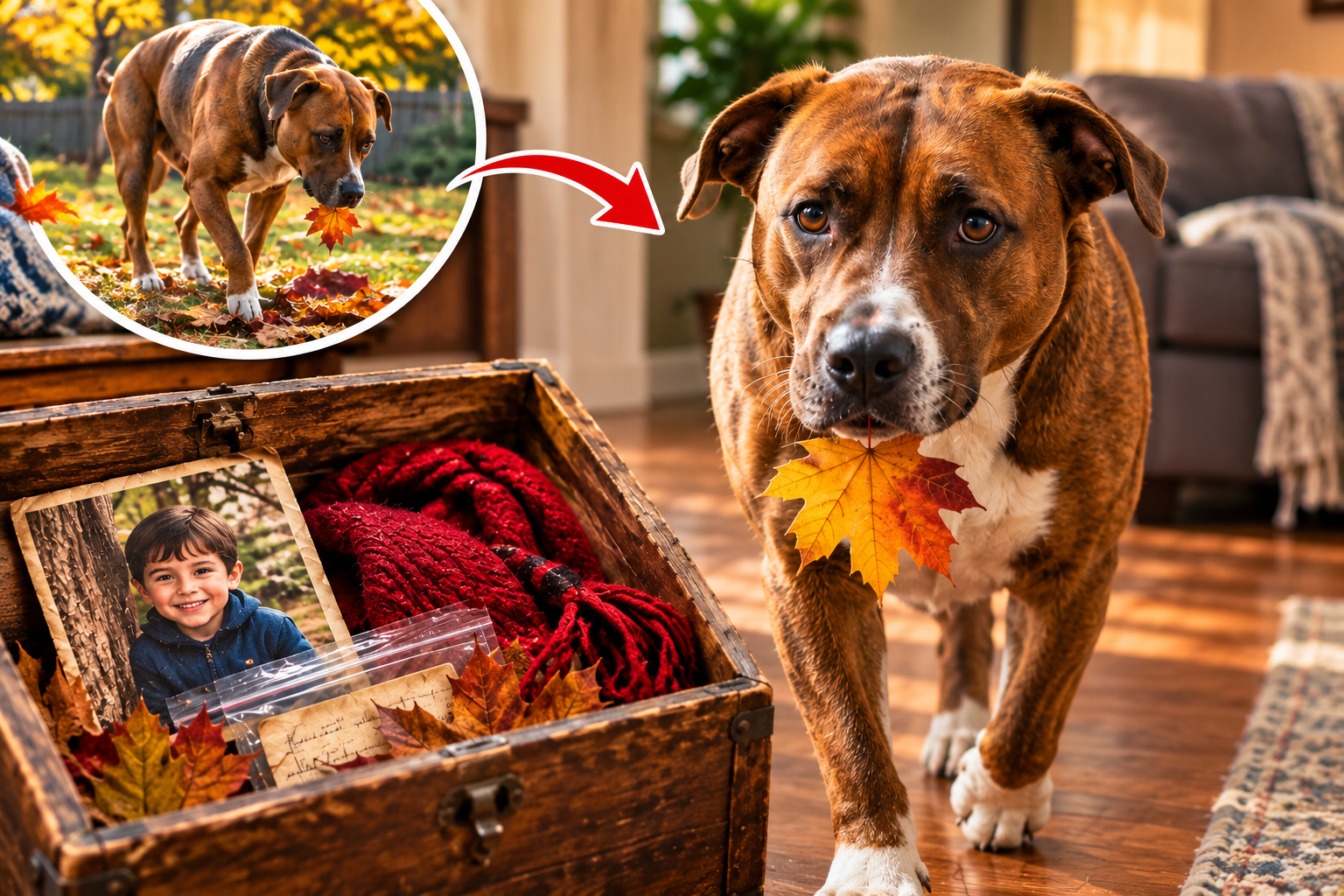
When I adopted Cooper, I expected the usual challenges of bringing a rescue dog home.
I expected accidents.
I expected chewed shoes.
I expected him to be nervous around strangers.
What I didn’t expect was a strange morning ritual that would continue for almost two years.
Every morning, Cooper would disappear into the backyard.
And every morning, he would return carrying a single dried leaf.
He never ate it.
He never played with it.
He simply carried it carefully through the house and placed it beneath the old wooden bench near my living-room window.
At first, I thought it was funny.
Eventually, I realized he was trying to tell me something.
The Dog Who Wouldn’t Leave the Backyard Alone
I adopted Cooper from a local rescue center after seeing his photograph online.
He was a large mixed-breed dog with warm brown eyes and a white patch across his chest.
The rescue worker told me he had been found wandering near an abandoned farmhouse.
Nobody knew exactly where he had come from.
He was gentle but unusually cautious.
Whenever someone raised their voice, Cooper lowered his head.
Whenever I opened an unfamiliar door, he stayed several steps behind me.
It took months before he finally trusted me enough to sleep beside my bed.
That was when I knew he had decided our house was his home.
But there was one part of the house that always seemed to make him nervous.
The wooden bench near the living-room window.
It had belonged to my grandmother.
It was old, scratched, and slightly crooked, but I couldn’t bring myself to throw it away.
Cooper seemed fascinated by the space beneath it.
The First Leaf
One October morning, I was making coffee when I heard Cooper scratching at the back door.
I opened it.
He ran outside.
About ten minutes later, he returned.
Something brown was hanging from his mouth.
At first, I thought it was a piece of cardboard.
Then he dropped it onto the floor.
It was a maple leaf.
Cooper picked it up again.
He walked directly toward the living room.
Then he carefully pushed the leaf beneath the wooden bench.
I laughed.
“Really, Cooper?”
He looked at me.
His tail moved once.
Then he walked away.
I pulled the leaf back out and threw it into the trash.
The following morning, he brought another one.
Same routine.
Same bench.
Same quiet determination.
I started wondering whether he had simply discovered a new game.
So I left him alone.
A Strange Daily Habit
The behavior continued.
One leaf every morning.
Sometimes the leaves were red.
Sometimes yellow.
Sometimes completely brown and curled.
But Cooper always chose just one.
He never carried branches.
He never brought several leaves at once.
He selected a single leaf, carried it indoors, and placed it under the bench.
After several weeks, I stopped removing them.
I became curious about how long he would continue.
Soon, the leaves formed a small pile.
Whenever I cleaned the living room, I moved them into a box.
Cooper would watch me.
Then the next morning, he would bring another.
It almost seemed as though he was replacing every leaf I removed.
My sister thought it was hilarious.
“You’ve got the world’s strangest dog,” she told me.
“Maybe he’s decorating.”
I smiled.
“Maybe.”
But deep down, I felt there was more to it.
The Day Cooper Refused to Come Inside
One winter morning, something changed.
Cooper went into the backyard as usual.
But this time, he didn’t come back.
I called his name.
Nothing.
I put on my coat and stepped outside.
He was standing beside the old apple tree at the far end of the yard.
He wasn’t digging.
He wasn’t sniffing.
He was simply staring at the ground.
Then he looked at me.
And slowly walked away from the tree.
I followed him.
He stopped beside the garden shed.
There, underneath a layer of wet leaves, was something I had never noticed before.
A small metal box.
Cooper touched it gently with his nose.
Then he looked at me.
I knelt down.
The box was badly rusted.
I pulled it from the soil.
There was no lock.
Inside was a collection of old photographs, a child’s red scarf, and several handwritten notes sealed inside plastic bags.
I had no idea who they belonged to.
The Name on the Photograph
One photograph immediately caught my attention.
It showed a little boy standing beside the same apple tree.
He was smiling.
Beside him was a much younger version of the wooden bench now sitting in my living room.
On the back of the photograph were four words:
“Evan — first autumn home.”
I stared at the picture.
Who was Evan?
And why were his things buried in my backyard?
I called my landlord.
He was an older man who had owned the property for decades.
When I showed him the photograph, his expression changed.
“You found that?”
“Do you know who Evan was?”
He sat down.
For several seconds, he didn’t answer.
Then he told me a story I never expected to hear.
The Boy Who Loved the Apple Tree
Years earlier, the house had belonged to a family named the Harrisons.
They had a young son named Evan.
Evan loved the backyard.
He especially loved the old apple tree.
According to my landlord, the boy used to collect leaves during autumn and keep his favorites in little envelopes.
He wanted to make a scrapbook when he grew older.
But that never happened.
Evan became seriously ill when he was young.
His parents eventually moved away to be closer to a hospital.
The house was sold.
The family took most of their belongings with them.
But apparently, some things were left behind.
Including the metal box.
I looked at Cooper.
“How did you know?”
He tilted his head.
I had no answer.
The Red Scarf
Inside the box was the child’s red scarf.
Cooper immediately became interested when I placed it on the floor.
He walked toward it slowly.
Then he sniffed it.
His entire body became still.
He lowered his head onto the scarf.
I had never seen him react to anything that way.
The landlord looked at him.
“Where did you get this dog?”
I explained that Cooper had been found near an abandoned farmhouse several miles away.
The landlord became quiet.
Then he asked something that made my heart stop.
“Was he already wearing a red collar?”
“Yes.”
“Was there a tiny metal tag on it?”
“Yes.”
He closed his eyes.
“That dog may have belonged to Evan’s family.”
The Missing Piece
I contacted the rescue center.
They searched their old records.
The information was limited, but there was one detail that stood out.
When Cooper had been found, he had been wearing a faded collar.
The collar had been removed before adoption because it was damaged.
The rescue worker remembered that the dog’s original tag had contained only one word:
Evan.
I felt chills run through me.
Cooper had not randomly chosen leaves.
He had spent nearly two years carrying pieces of autumn back into the house.
Perhaps it was instinct.
Perhaps it was memory.
Perhaps he simply loved the smell of the old tree.
I couldn’t prove why he did it.
But suddenly, his strange ritual didn’t feel strange anymore.
It felt like a connection to a life that had disappeared long before I arrived.
I Called the Family
Using the information from my landlord, I eventually found Evan’s mother.
Her name was Margaret.
I told her about the metal box.
There was a long silence on the phone.
Then she began crying.
She told me Evan had owned a dog when he was little.
His name had been Cooper.
The family had lost track of the dog after leaving the house.
They had assumed he had been adopted by someone else.
Margaret asked if she could meet him.
I agreed.
The Reunion
A week later, Margaret arrived at my house.
She looked nervous.
Cooper was lying beside the fireplace.
When she stepped through the door, he lifted his head.
For several seconds, nothing happened.
Then Cooper stood.
He walked toward her.
Margaret knelt down.
She didn’t call his name.
She didn’t reach for him.
She simply waited.
Cooper sniffed her hands.
Then he rested his head against her shoulder.
Margaret began to cry.
She wrapped her arms around him.
“Oh, my boy,” she whispered.
Cooper stayed perfectly still.
I stood across the room trying not to cry myself.
It was one of those moments that didn’t need an explanation.
The Leaves Had a New Meaning
Margaret later explained that Evan used to bring leaves inside during autumn.
He would choose one special leaf every day and place it beside his bed.
His mother had often teased him about it.
“He always said every leaf had a story,” she told me.
I looked toward the wooden bench.
For nearly two years, Cooper had been collecting leaves beneath it.
Maybe he wasn’t trying to hide them.
Maybe he was keeping something safe.
Maybe he was repeating a habit he had learned long ago from a little boy who had loved the same backyard.
We would never know for certain.
But I stopped throwing the leaves away.
Instead, I placed a small wooden box beside the bench.
Whenever Cooper brought one inside, I put it there.
Over time, the box filled.
Two Years Later
Cooper still collects leaves.
He doesn’t do it every single morning anymore.
He’s older now.
Some mornings, he simply sleeps in the sunlight.
But every autumn, when the maple tree turns gold, he becomes interested again.
He walks outside.
Chooses one leaf.
Carries it through the house.
And places it beneath the bench.
Margaret still visits several times a year.
Whenever she comes, she brings photographs of Evan.
We sit together and remember a boy neither of us knew in the same way, but both of us somehow came to love.
One afternoon, Margaret looked at the box of leaves and smiled.
“I used to think Evan was wasting his time collecting these.”
I laughed softly.
“Maybe he knew something we didn’t.”
She nodded.
“Maybe he did.”
What Cooper Taught Me
Before Cooper came into my life, I believed animals lived mostly in the present.
Eat.
Sleep.
Play.
Repeat.
But watching him taught me something different.
Animals notice things we overlook.
They remember smells.
Places.
Voices.
Routines.
People.
And sometimes, their strange little habits may carry stories we don’t understand.
I still don’t know exactly why Cooper collected those leaves.
Maybe he remembered Evan.
Maybe he remembered the house.
Maybe the behavior simply became part of his life.
But I do know this:
Every time I see a single autumn leaf lying beneath that old wooden bench, I think about how love can survive in unexpected forms.
Sometimes it survives in photographs.
Sometimes in memories
.And sometimes, incredibly, it survives in the quiet habits of a rescue dog who refuses to forget.
Cooper never told me what those leaves meant.
But somehow, he didn’t have to.