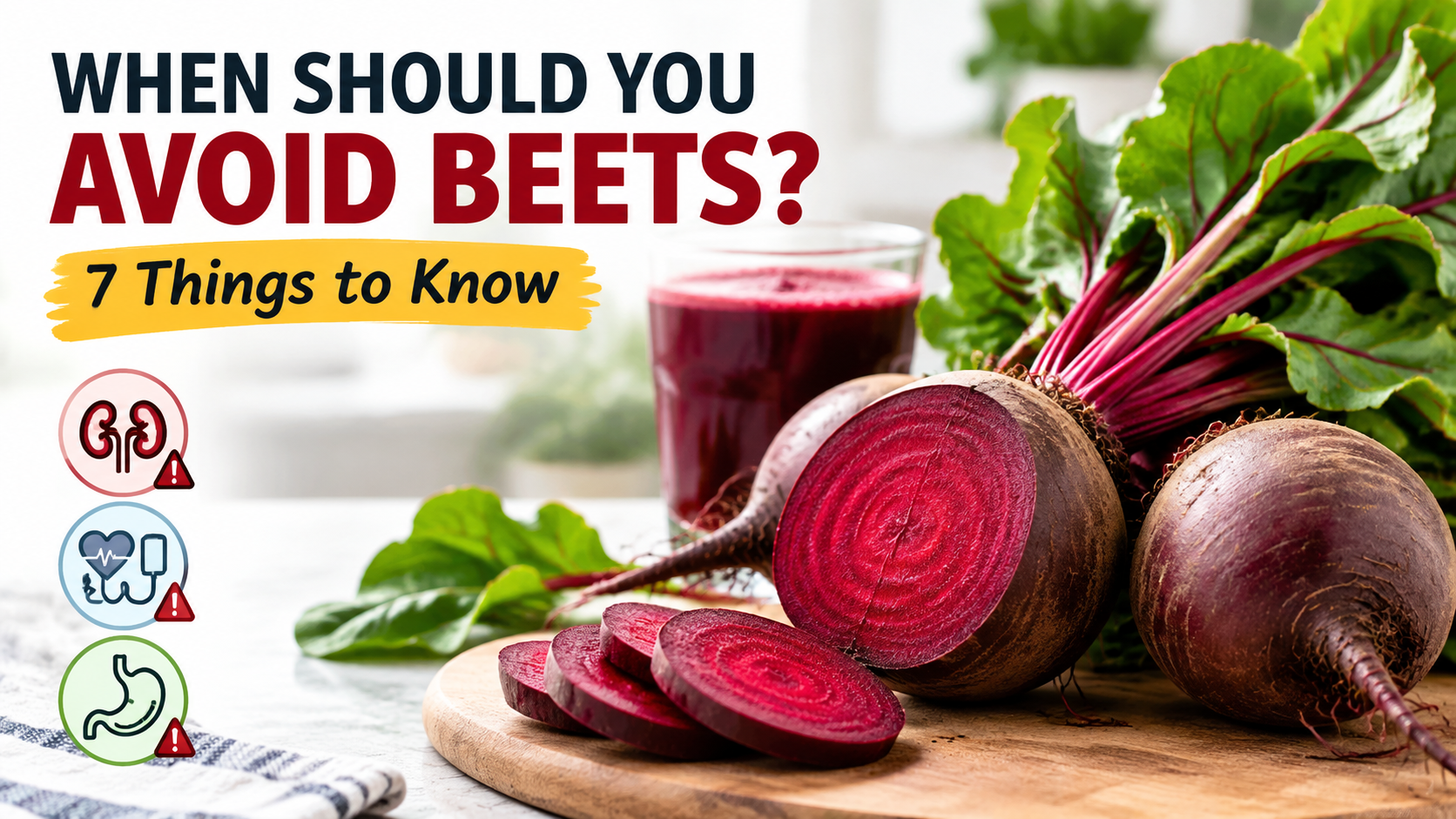
Beets are one of those vegetables that can easily earn a place on a healthy plate. Their deep red-purple color comes from natural plant compounds, and they provide nutrients such as folate, potassium, and fiber. Beetroot also contains naturally occurring nitrates, which have been studied for their potential effects on blood pressure and blood-vessel function.
But “healthy” does not necessarily mean “right for everyone” or “better in unlimited amounts.”
For certain people, especially those who have a history of particular kidney stones or who take medication that affects blood pressure, consuming large amounts of beetroot or concentrated beet juice may require extra caution.
So, when should you avoid or limit beets?
Here are seven situations worth knowing about.
1. If You Have a History of Calcium Oxalate Kidney Stones
One of the biggest reasons some people need to be careful with beets is their oxalate content.
Oxalates are naturally occurring compounds found in a variety of plant foods. For people who are susceptible to calcium oxalate kidney stones, consuming large amounts of high-oxalate foods may contribute to the amount of oxalate in the urine.
The National Kidney Foundation lists beets among foods that are very high in oxalate. However, this does not mean everyone should eliminate beets from their diet.
For someone with a history of calcium oxalate stones, the right dietary approach depends on their individual urine chemistry and medical history. A healthcare professional or registered dietitian can help determine whether limiting beets is appropriate.
2. If You Already Have Low Blood Pressure
Beets are naturally rich in dietary nitrate. The body can convert nitrate into nitric oxide, a compound involved in blood-vessel relaxation.
Research has found that beetroot juice can lower blood pressure, particularly systolic blood pressure, in some adults.
That can be beneficial for people with elevated blood pressure—but it may be less desirable for someone who already has unusually low blood pressure.
If you frequently experience dizziness, faintness, or weakness related to low blood pressure, don’t assume that drinking large quantities of beet juice is harmless simply because beets are considered healthy.
It’s better to discuss your diet with a healthcare professional, particularly if you take medication for blood pressure.
3. If You Take Blood-Pressure Medication
Beets don’t automatically have to be removed from the diet when someone takes blood-pressure medicine.
The concern is mainly with large or concentrated amounts, such as frequent beet juice or supplements, because dietary nitrate may contribute to blood-pressure reduction.
Clinical research has found a blood-pressure-lowering effect from beetroot juice in some studies, although the size of the effect varies between individuals and studies.
If you’re taking medication to control hypertension and want to start consuming large amounts of beet juice, talk with your doctor or pharmacist first.
Food should complement medical treatment—not replace prescribed medication.
4. If Beet Juice Causes Digestive Problems
Whole beets contain fiber, while beet juice is a more concentrated form of the vegetable and contains considerably less fiber.
Some people may notice digestive discomfort after consuming large amounts of beetroot or beet juice. Possible symptoms can include stomach discomfort, changes in bowel movements, or nausea.
If this happens, reducing the portion or choosing whole cooked beets instead of a large glass of juice may be worth trying.
A food does not need to be completely removed simply because a large serving doesn’t agree with your stomach.
5. Be Careful With Large “Detox” or Juice Cleanses
A common mistake is assuming that because beets are nutritious, drinking huge quantities of beet juice must be even healthier.
That’s not necessarily true.
Beet juice is often included in “detox” or cleansing routines. However, health authorities caution against extreme detox programs and note that some juice-based cleanses contain high-oxalate foods such as beets.
Rather than relying on a restrictive juice cleanse, a balanced diet containing vegetables, fruits, whole grains, protein, and adequate fluids is generally a more sensible approach.
If you’re considering a prolonged juice cleanse, particularly if you have a medical condition, speak with a healthcare professional first.
6. Don’t Confuse Red Urine With a Medical Emergency—But Know the Difference
After eating beets, some people notice that their urine becomes pink, red, or reddish-purple.
This phenomenon is commonly called beeturia and can occur because beet pigments pass through the digestive system and are excreted in the urine.
Seeing red urine after eating beets can therefore be harmless.
However, you should not automatically assume that every episode of red urine is caused by beets.
If the discoloration occurs when you haven’t recently eaten beets, lasts unexpectedly, or comes with pain, burning, blood clots, fever, or other concerning symptoms, medical evaluation is appropriate.
7. More Is Not Always Better
Another important point is portion size.
Beets can be part of a nutritious diet, but you don’t need enormous servings to make them “healthy.” Concentrated beetroot juice and beet supplements can deliver substantially more of certain compounds than a normal serving of whole vegetables.
Instead of treating beetroot like a miracle food, think of it as one nutritious food among many.
You can rotate beets with other vegetables and build a diet that provides a wide range of nutrients.
So, Are Beets Healthy?
For most people, beets can be a nutritious addition to a balanced diet.
Research on dietary nitrate and beetroot juice has found potential benefits for blood pressure and vascular health. Several systematic reviews and meta-analyses have reported modest reductions in blood pressure after beetroot or nitrate supplementation.
However, the research does not mean that beets are a treatment for hypertension, nor does it mean everyone should consume large quantities of beet juice.
The potential benefits need to be considered alongside individual circumstances.
Who Should Be Especially Careful With Beets?
Extra caution may be appropriate if you:
- Have a history of calcium oxalate kidney stones
- Have unusually low blood pressure
- Take medication that lowers blood pressure
- Experience digestive symptoms after eating beets
- Are considering a concentrated beetroot supplement
- Are planning a prolonged juice or “detox” diet
- Have been advised by your healthcare professional to follow an oxalate-restricted diet
This doesn’t automatically mean you can never eat beets. In many cases, the issue is quantity, preparation, or your individual medical situation.
Whole Beets vs. Beet Juice: Is There a Difference?
Yes.
Whole beets provide fiber and are eaten as part of a complete meal. Beet juice is more concentrated and can make it easier to consume a larger amount of beetroot in a short period.
For everyday eating, whole beets can be an easy way to include vegetables in your diet.
If you use beet juice specifically because of its nitrate content, remember that studies have used different amounts, preparations, and durations, so there isn’t one universal “perfect” dose for everyone.
The Bottom Line
Beets deserve their reputation as a nutritious vegetable, but they aren’t a magic food—and they aren’t necessarily appropriate in large quantities for every person.
The biggest reason for caution is particularly relevant to people who are prone to calcium oxalate kidney stones because beets are high in oxalate. People with low blood pressure or those using blood-pressure medication should also be thoughtful about consuming concentrated beetroot products.
For most healthy adults, moderate portions of whole beets can fit comfortably into a varied diet.
The goal isn’t to fear beets. It’s to understand how a food fits into your own health needs, medications, and overall diet.
If you have kidney stones, blood-pressure concerns, or another medical condition, ask your healthcare professional before making a major dietary change.