I never imagined that the person I had spent most of my life protecting would one day look across the kitchen table and tell me I was making her life miserable.
But that is exactly what happened.
And what my daughter didn’t know was that, by that point, I had already made a decision.
I simply hadn’t told anyone yet.
The Conversation I Couldn’t Forget
My name is Eleanor, and I’m sixty-one years old.
After my husband passed away, I stayed in the little house we had built together. It wasn’t luxurious, but it was comfortable, paid off, and filled with memories.
My daughter, Megan, and her husband had been struggling financially.
Their rent had increased. My son-in-law’s hours had been reduced. They had a little boy, and every month seemed to bring another expense.
So when Megan called me one evening and asked whether they could stay with me for a few months, I didn’t hesitate.
“Of course,” I told her.
She cried with relief.
I thought I was helping my daughter get back on her feet.
I didn’t realize I was slowly becoming responsible for everyone else’s life.
At first, everything seemed fine.
Then the small complaints began.
Megan complained that my furniture looked old.
Her husband complained that I didn’t buy the groceries they preferred.
They started using my car without asking.
I paid the electricity, internet, insurance and property taxes.
I also began covering their son’s school expenses because Megan said they were “temporarily short.”
Temporary became six months.
Six months became a year.
And eventually, nobody talked about moving out anymore.
The Words That Changed Everything
One Friday evening, I was preparing dinner when Megan walked into the kitchen.
She looked exhausted.
“Mom, can we talk?”
I turned off the stove.
“Of course.”
She sighed.
“You need to understand that things can’t continue like this.”
I was confused.
“What do you mean?”
She crossed her arms.
“You’ve become the center of every problem in this house.”
I stared at her.
She continued.
“Everything has to be done your way. You’re always asking where we are, what we’re spending, what we’re doing.”
I almost laughed.
I had never asked what they were spending.
I was the one paying most of the bills.
Then she said the sentence I would remember for the rest of my life.
“Sometimes I feel like you’re a burden on us.”
The kitchen became completely silent.
For several seconds, I couldn’t speak.
I looked at my daughter and wondered when helping her had turned into something she considered an inconvenience.
Finally, I nodded.
“Thank you for telling me.”
She seemed surprised that I didn’t argue.
But I had learned something that night.
When someone tells you how they truly see you, believe them.
I Stopped Explaining Myself
The following morning, I changed my routine.
I didn’t wake everyone up.
I didn’t prepare breakfast.
I didn’t remind anyone about appointments.
Most importantly, I stopped paying for things that weren’t mine.
Megan noticed immediately.
“Mom, we’re almost out of groceries.”
“I know.”
“Can you go shopping?”
“No.”
She stared at me.
“Why not?”
“Because I’m buying groceries for myself now.”
She laughed nervously.
“Are you seriously angry because of what I said?”
“No,” I replied.
“I’m simply listening to you.”
That answer ended the conversation.
For the first time in months, I began looking at my own life.
I went through my bank statements.
I added up the money I had spent helping my daughter and her family.
The total shocked even me.
School expenses.
Car repairs.
Utilities.
Groceries.
Insurance.
Medical bills.
Furniture.
And countless smaller payments I had made without thinking twice.
I wasn’t angry about helping.
I was angry that my help had become invisible.
The Envelope in My Desk
A few days later, I opened an old desk drawer.
Inside was an envelope my husband had left behind.
It contained documents relating to our house.
The property was completely in my name.
I sat there for a long time reading the papers.
Then I made a phone call.
Not to Megan.
Not to my son-in-law.
To a financial adviser.
I needed to understand what my future would look like if I stopped rescuing everyone else.
For the first time in years, I made plans based entirely on what I wanted.
I decided to renovate the small guest room into a private office.
I arranged for my car to be serviced.
I booked a short trip to the coast.
And I opened a separate savings account for my own future.
I didn’t announce any of it.
I simply started living differently.
The Sunday Dinner
Two weeks later, Megan invited several relatives over for Sunday dinner.
She said she wanted everyone together.
I agreed.
There were eight people around the table.
My daughter.
Her husband.
My grandson.
My sister.
Two cousins.
And me.
Halfway through dinner, Megan cleared her throat.
“Mom, we need to talk about the house.”
I put down my fork.
“All right.”
She exchanged a look with her husband.
“We’ve been thinking that maybe it would be better if you moved somewhere smaller.”
Nobody spoke.
My sister looked at me.
Megan continued.
“The house is too much for you, and honestly, it would make more sense for us to stay here.”
I almost smiled.
They had apparently already decided what my future should look like.
Then my son-in-law added,
“We could take over the maintenance and expenses.”
That was when I reached into my purse.
I placed a folder on the table.
Megan frowned.
“What’s that?”
“Everything you need to know.”
She opened it.
Inside were copies of the house documents, my recent financial statements and a letter from my attorney.
Her face changed.
“What is this?”
I took a slow breath.
“I’ve decided to keep the house.”
Her husband looked confused.
“Obviously. We just thought—”
“I know what you thought.”
I looked directly at my daughter.
“But there is something else.”
I slid another document across the table.
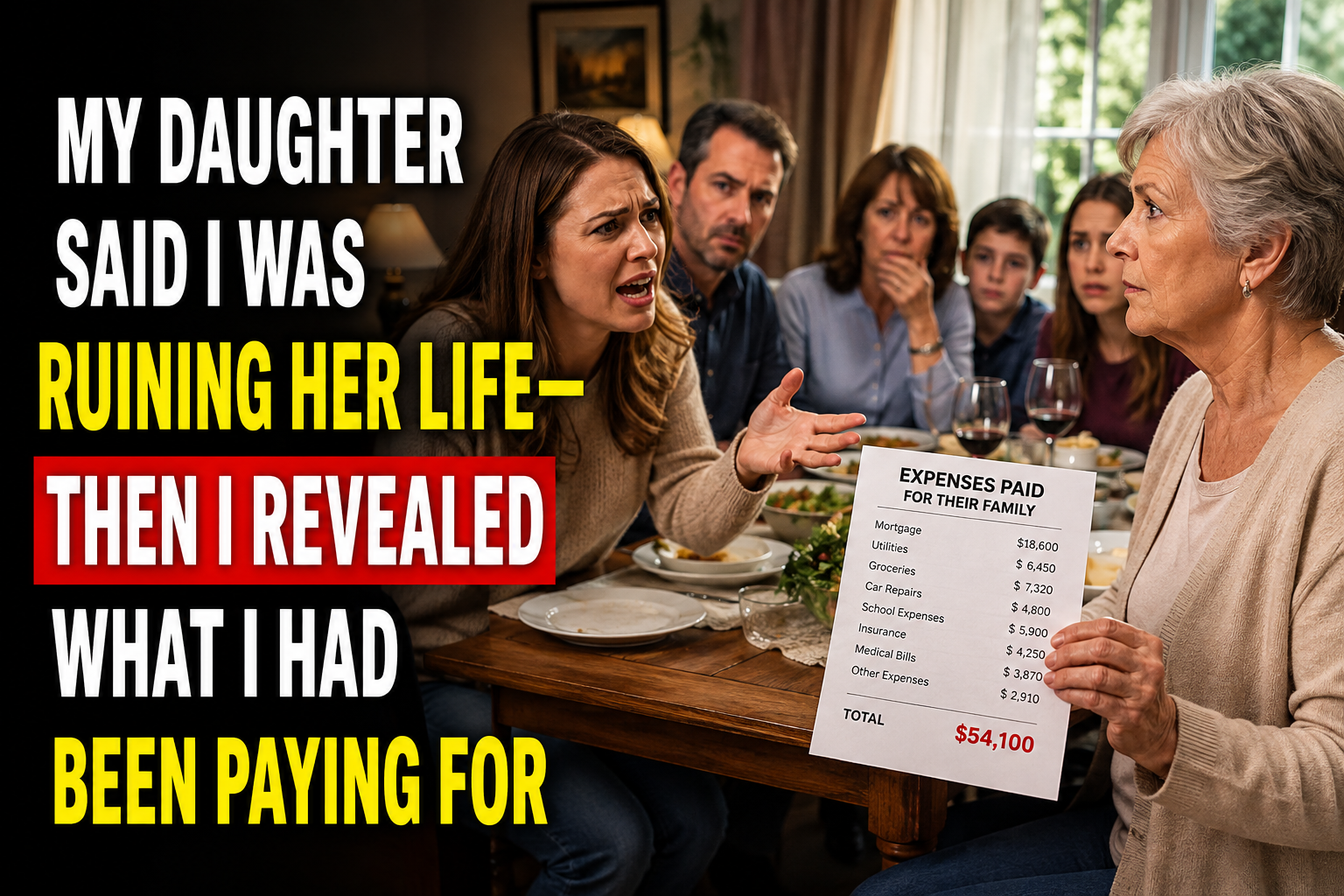
It was a list of every major expense I had paid for them during the previous year.
The total was highlighted at the bottom.
Megan’s eyes widened.
“You paid all of this?”
“Yes.”
Nobody spoke.
I continued.
“I never showed you because I didn’t help you so that you would owe me.”
My voice remained calm.
“But you called me a burden while I was carrying expenses you couldn’t afford.”
Megan looked down at the table.
Her husband didn’t say anything.
The Decision Nobody Expected
I wasn’t interested in humiliating them.
I simply wanted my life back.
“I am not throwing you out tonight,” I said.
“But the arrangement is changing.”
I gave them sixty days to find another place.
From that day forward, they would contribute toward the household expenses until they moved.
There would be no more free groceries.
No more unpaid bills.
No more borrowing my car.
No more treating my home like a hotel.
Megan started crying.
“Mom, I didn’t mean it like that.”
“I know,” I said softly.
“But words still have consequences.”
She reached for my hand.
For the first time in months, I saw my daughter not as someone who needed rescuing, but as an adult capable of rebuilding her own life.
And perhaps that was the greatest help I could finally give her.
What Happened Afterward
The next two months weren’t easy.
There were arguments.
There were tears.
There were moments when I questioned whether I had been too harsh.
But slowly, things changed.
Megan found a smaller apartment.
Her husband picked up additional work.
They started managing their own bills.
And I started sleeping better.
Six months later, Megan came to visit me.
She looked different.
More confident.
More independent.
She sat beside me in the garden.
“Mom,” she said quietly, “I owe you an apology.”
I didn’t say anything.
She continued.
“I thought you were controlling my life. I didn’t realize how much you had been doing for us.”
I smiled.
“I’m glad you understand now.”
She hugged me.
This time, there was no request attached to it.
No bill.
No emergency.
No favor.
Just my daughter.
The Lesson I Learned
For years, I believed being a good mother meant constantly giving.
I thought saying no made me selfish.
I thought setting boundaries meant I loved my family less.
I was wrong.
Sometimes the most loving thing you can do for someone is stop doing everything for them.
People can become so accustomed to your sacrifices that they stop seeing them as sacrifices at all.
And when that happens, you have to decide whether you’re helping someone grow—or simply helping them remain dependent.
That Sunday dinner changed my relationship with my daughter.
Not because I punished her.
Because I finally stopped abandoning myself.
I wasn’t a burden.
I had simply spent too many years carrying everyone else’s weight.
And once I put it down, I finally had room to breathe.

